

You say something. Then you hear a joke hiding inside it. Your face turns red, and you quickly add, “No pun intended.” Almost everyone has done this at least once.
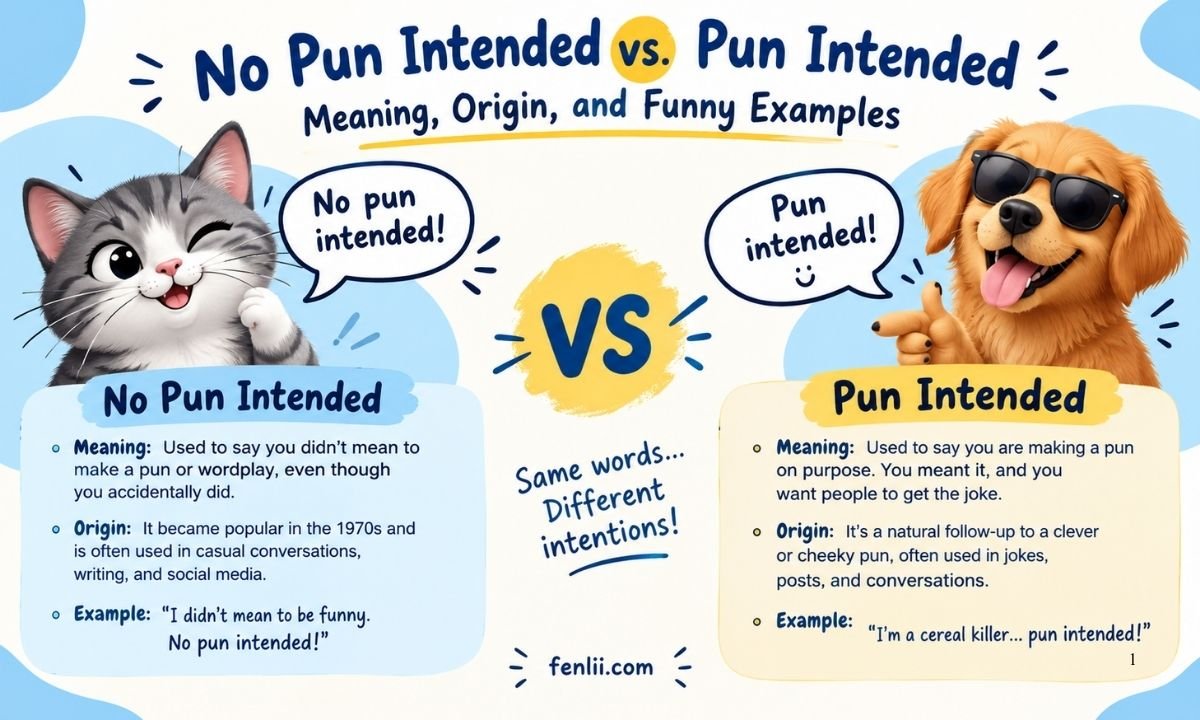
These two little phrases do a big job in conversation. One says, “I meant that joke.” The other says, “That joke was an accident.” In this guide, you will learn what each phrase means, where it came from, and why people love using it.
Understanding the No Pun Intended Meaning & Definition
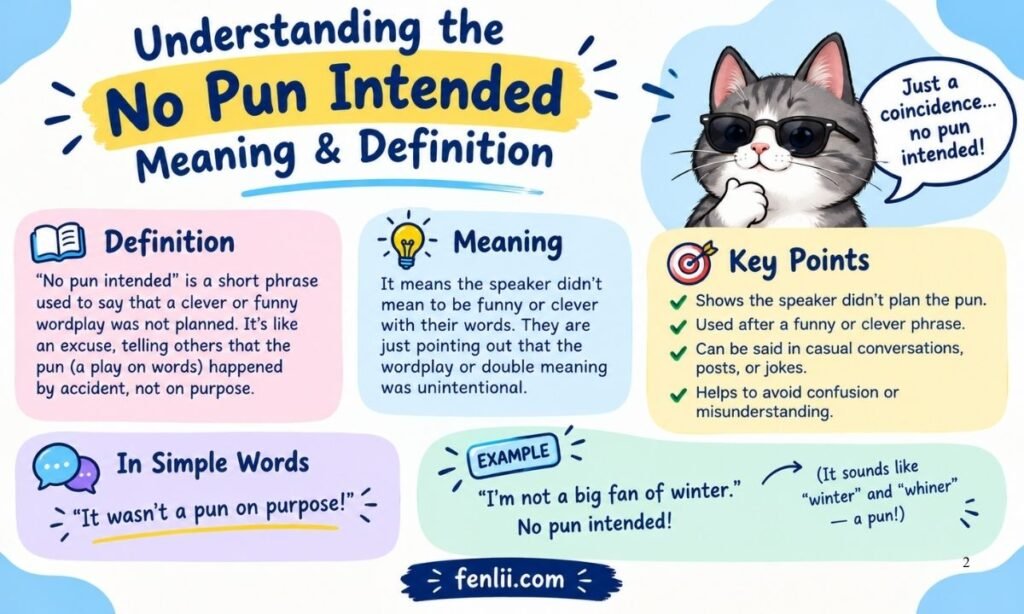
“No pun intended” means you did not mean to make a joke. A pun is a play on words. It uses a word with two meanings, or two words that sound alike.
Sometimes a pun slips out by accident. You notice it right after you say it. So you add “no pun intended” to show you did not plan it. It is a small apology and a small wink at the same time.
Quick example: “The bakery is rising to the occasion, no pun intended.”
Here, “rising” works for bread and for success. The speaker did not mean to be funny. Or at least, they say so.
Why this phrase works
- It points out the joke before anyone else can.
- It keeps the speaker sounding serious.
- It invites the listener to smile.
Where Does “No Pun Intended” Come From? (Origin & History)
There is no single inventor of this phrase. No one can point to the first person who said it. It grew out of everyday speech, much like many idioms do.
The word “pun” itself is old. It has been used in English since the 1600s. People have loved wordplay for much longer than that. As puns became a common part of talk and writing, speakers needed a quick way to say, “That was not on purpose.”
So the phrase likely took shape naturally. It filled a gap in spoken English. Today it is a standard idiom found in dictionaries, books, news writing, and casual chats.
A fair note: Because the exact first use is unclear, be careful with websites that name a specific “inventor.” Most of those claims have no solid proof.
Accidental Puns vs Intentional Wordplay
Not all puns are the same. Some are planned. Some just happen.
Intentional wordplay is crafted. The speaker picks the words on purpose. Stand-up comics, headline writers, and ad teams do this all the time.
Accidental puns appear by chance. The speaker is talking about something serious. Then a word with a double meaning sneaks in. The humor lands because the speaker did not plan it.
| Feature | Accidental Pun | Intentional Pun |
| Planned? | No | Yes |
| Usual phrase | “No pun intended” | “Pun intended” |
| Mood | Surprise, mild embarrassment | Pride, playful humor |
| Common place | Casual talk | Jokes, ads, headlines |
Accidental puns often get the bigger laugh. The surprise does half the work.
“Pun Intended” vs “No Pun Intended”: What Is the Difference?
The difference is the speaker’s intent.
“Pun intended” means, “Yes, I made that joke on purpose.” The speaker is proud of the wordplay. They want you to notice it.
“No pun intended” means, “I did not plan that joke.” The speaker is a bit surprised. They want you to know it was a slip.
Examples:
- “I’m reading a book on anti-gravity. It’s impossible to put down, pun intended.”
- “The film was a real gas, no pun intended,” said the man talking about the gas station thriller.
A small secret
Many people use “no pun intended” even when they did plan the pun. It is a playful way to deliver a joke while acting innocent. In this case, it works like a joke on top of a joke.
Why Do People Say “No Pun Intended” in Daily Life?
People use this phrase for a few clear reasons.
- To avoid sounding rude. Sometimes a pun touches a sad or serious topic. The phrase shows you did not mean to make light of it.
- To own the joke. Pointing it out first feels confident and funny.
- To keep the mood light. A small laugh can ease a tense chat.
- To show wit. It tells others you notice language.
- To fill the pause. A quick phrase can rescue an awkward moment.
You will hear it at work, at dinner tables, in classrooms, and on podcasts. It is friendly, short, and easy to remember.
ALSO READ THIS PUNS : Shrimp Puns
Best Funny Examples of “No Pun Intended” Phrases
Here are some fun examples you can borrow. Each one shows how a double meaning can sneak in.
- “I told my boss I was feeling a little under the weather. He said I looked a bit pale, no pun intended.”
- “Our football team is on a roll, no pun intended,” said the baker, handing out bread.
- “The electrician’s new business is taking off. He is really well-connected, no pun intended.”
- “That dentist’s reviews are amazing. People say he is a real stand-up tooth-fairy, no pun intended.”
- “The gardener said her plan was growing on her, no pun intended.”
- “I’m bored of this elevator ride. It has its ups and downs, no pun intended.”
- “The new bridge is a real link between the towns, no pun intended.”
- “The chef got fired for burning the sauce. It was the last straw, no pun intended.”
Everyday moments
- A teacher says, “Let’s get to the root of the problem, no pun intended,” during a lesson on plants.
- A pilot says, “We expect a smooth landing, no pun intended.”
- A fisherman says, “I’m hooked on this hobby, no pun intended.”
These work because the topic and the word match too well.
Modern Internet Culture: “No Pun Intended” in Memes
The internet loves wordplay. “No pun intended” shows up in captions, tweets, comment sections, and short videos.
Creators often use it as a punchline. They write a serious sentence, then add the phrase after an obvious pun. The more obvious the pun, the funnier the joke.
You will also see it in reply threads. One person posts a pun. Another replies, “No pun intended?” with a laughing emoji. This back-and-forth has become a small online game.
Some people now use the phrase ironically. They plan the pun and still say “no pun intended.” Readers know the trick, and that is exactly why it is funny.
So yes, the phrase is still alive and well. It fits quick, short, shareable content perfectly.
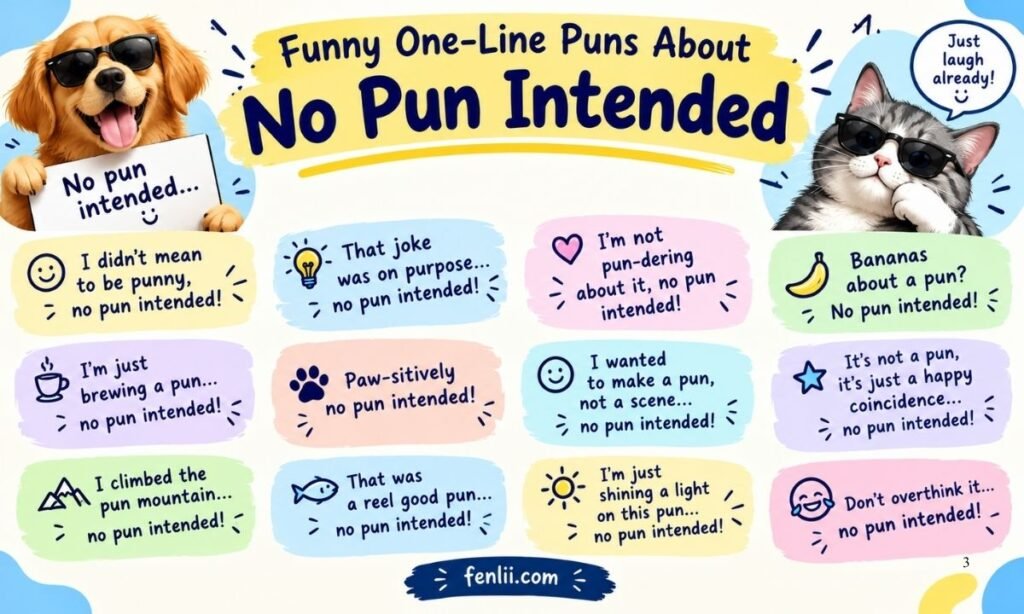
Funny One-Line Puns About “No Pun Intended”
- I wanted to write a book on puns, but I ran out of words. No pun intended.
- Accidental puns are the best because they come out of nowhere. No pun intended.
- My friend said I make too many puns. I told him that is just how I roll, no pun intended.
- The clock shop is doing well. Business is ticking along, no pun intended.
- I started a bakery, and sales are on the rise, no pun intended.
- The mattress store is closing. Their prices were a real dream, no pun intended.
- The tailor was sad because his business was suit-ably small, no pun intended.
- I lost my job at the calendar factory. I only took a few days off, no pun intended.
- The gardener quit. He said the job had no real roots, no pun intended.
- The baker went broke. He just could not make enough dough, no pun intended.
- My phone battery died at the worst time. I was totally drained, no pun intended.
- The skeleton skipped the party. He had no body to go with, no pun intended.
- The fisherman’s new boat was a catch, no pun intended.
- The coffee shop sells fast. It is a real grind, no pun intended.
- I told a joke about paper. It was tearable, no pun intended.
- The pilot loved his job. It was a high point in his life, no pun intended.
- The shoemaker’s shop was sole-ly owned by one man, no pun intended.
- The librarian was quiet about her plans. They were novel, no pun intended.
- The math book looked sad. It had too many problems, no pun intended.
- I could say more about puns, but I will stop here. I do not want to push my luck, no pun intended.
Frequently Asked Questions (FAQs)
What does “no pun intended” mean?
It means the speaker did not plan to make a joke. A word they used happened to have a second, funny meaning.
What is the difference between “pun intended” and “no pun intended”?
“Pun intended” means the joke was on purpose. “No pun intended” means the joke was an accident, or is pretending to be one.
Where does “no pun intended” come from?
It has no known single source. It grew from everyday English as puns became common in speech and writing.
Is “no pun intended” still funny today?
Yes. It still gets smiles in chats, memes, and social posts. It works best when the pun is clever and the timing is quick.
How do you use “no pun intended” in a sentence?
Add it right after the pun. For example: “The movie was a real blast, no pun intended,” said the fireworks fan.
Final Thoughts
“No pun intended” is a tiny phrase with a big personality. It lets you admit a funny slip, or pretend you made one. Either way, it adds humor to a plain sentence.
“Pun intended,” on the other hand, says you meant every word. Both phrases celebrate how playful English can be. Next time a pun sneaks into your talk, you will know exactly which phrase to reach for. And if you meant it all along, no one has to know.
1 thought on “No Pun Intended vs. Pun Intended: Meaning, Origin, and Funny Examples”